Open Appeal to Members of the Kurultai
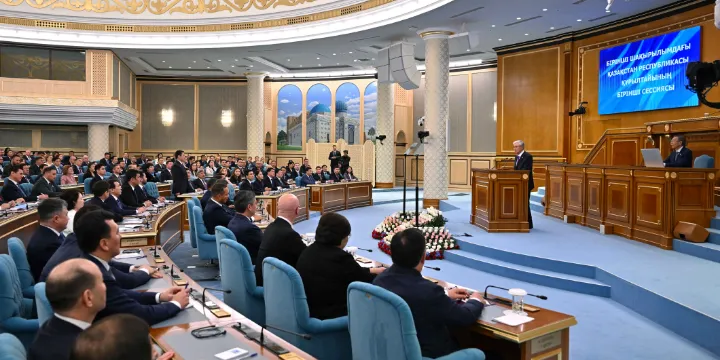
We call on members of parliament not to turn security rules into a tool for restricting journalistic activity
The Legal Media Center Public Foundation, the Adil Soz Foundation for Protection of Freedom of Speech, the MediaNet International Center for Journalism, and the Kazakhstan International Bureau for Human Rights and Rule of Law express concern over changes to the procedures governing journalists’ work in the building of the Kurultai of the Republic of Kazakhstan.
According to the information available, interaction between media representatives and members of parliament is expected to take place in a specially designated press center, while journalists may only be allowed to move around the building when accompanied. At the same time, these restrictions are not reflected in the published accreditation rules for journalists or in any other formally adopted documents regulating the work of media representatives in the Kurultai.
This situation raises concerns in terms of legal certainty and the predictability of the requirements being applied. Any restrictions affecting journalistic activity must have a clear legal basis, be formally established, and be applied according to transparent and consistent rules.
The Constitution of Kazakhstan guarantees freedom of expression, prohibits censorship, and establishes everyone’s right to freely receive and disseminate information. The Law “On Mass Media” explicitly grants journalists the right to visit government bodies, be received by public officials, attend events held by the body that accredited them, and make audio, photo and video recordings, except in cases established by law.
Security requirements and internal access rules in government buildings are both legitimate and necessary. However, their application must not result in disproportionate restrictions on journalists’ professional rights or their ability to obtain information of public interest.
A journalist should not be required to arrange in advance to speak with the “right” member of parliament, wait for them in a specially designated area, and ask only those questions that are convenient for the parliamentary administration to organize. Informal communication is an essential part of parliamentary journalism. The ability to approach a member of parliament immediately after a session, ask a follow-up or uncomfortable question, and obtain a comment on a pressing issue is standard media practice in a democratic parliament.
It is particularly concerning that such restrictions are being introduced immediately after the parliamentary elections and during the first days of the new Kurultai’s work. This is precisely the time when society needs to understand how the newly elected members of parliament are working, what positions they hold, how they respond to criticism, and whether they are prepared to answer questions from citizens and the media.
We call on the administration and leadership of the Kurultai of the Republic of Kazakhstan to ensure transparency regarding the rules currently governing the work of media representatives and to bring the procedures being applied in practice into line with officially adopted documents and the legal guarantees protecting journalists’ professional activities.
We call on political parties and parliamentary factions in the Kurultai to strengthen communication between members of parliament, political parties and the media, recognizing that media audiences have the right to know about legislative work, the decisions taken by members of parliament, and the laws being developed within the Kurultai.
Parliamentary openness and security are not mutually exclusive objectives. Both must be ensured through a proper balance between security requirements and the public’s right to receive information about the work of the legislature.
Legal Media Center Public Foundation
Adil Soz Foundation for Protection of Freedom of Speech
MediaNet International Center for Journalism
Kazakhstan International Bureau for Human Rights and Rule of Law